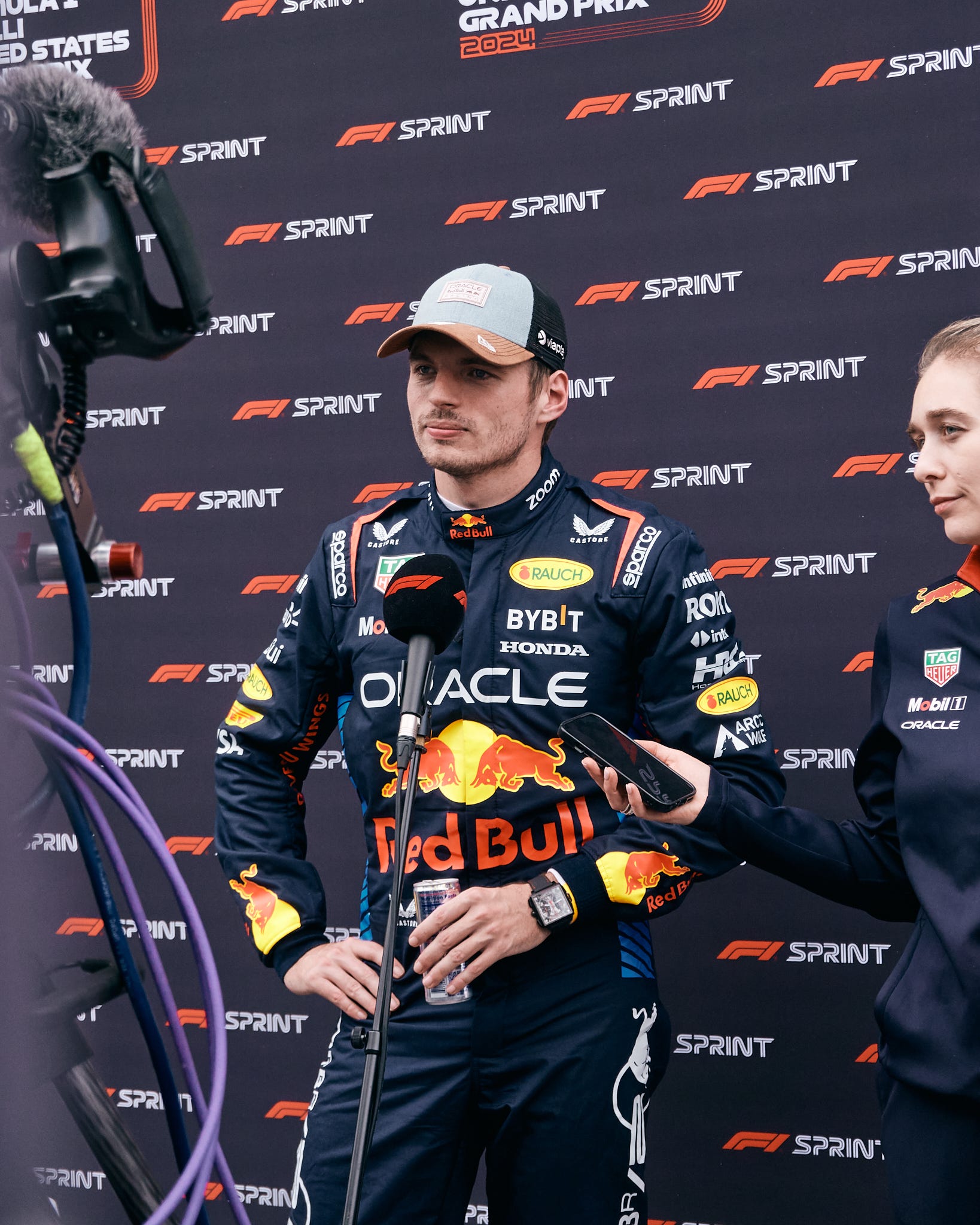
A Sit Down with Max Verstappen
The 4-time champion speaks with Esses on finding fun and his future in F1

Stefan Johansson spends his time painting these days, but for decades, his life was spent in race cars. Ever since our conversation last year, I’ve found myself thinking back to his recollections of the Monaco GP.
In the Issue 03 profile, he explained: “In Monaco, in 1985, his 500-kilo Ferrari had 1,500 horsepower. ‘So going into the braking area after the tunnel, we were doing 350 kilometers per hour,’ he says. ‘It was like a fucking missile.’ The car danced and he had to keep his foot all the way down as he shifted as quickly as possible. If he let it go, the Ferrari might shoot straight into a wall. ‘You need to push it just that little bit farther to make the difference and then you get into that sort of gray area where you’re not quite sure what’s gonna happen,’ he continues. ‘It’s an unbelievably liberating state of mind.’
That sense of tip-toeing right along the line between safety and disaster feels much less present at Monaco these days. But the race, and all the romance around it, still holds a special place in F1’s collective imagination. For many of the biggest drivers in the sport, it has also become a home race.
Max Verstappen has lived in Monaco since 2015. This week, in an Esses exclusive, the four-time champion told us allabout street circuits, never overcomplicating things, and the hope that finding fun on tracks outside the sport may help him “find that fun again in Formula 1.”

Max Verstappen on Finding Fun and his Future in Formula 1
By Toni Cowan-Brown
Toni: You have described this track as chaotic and hectic, and potentially not your favorite place to race. But what does Monaco mean to you?
Max: Monaco means home to me, to be honest. I love living here.
It is a very tough race to win. A lot of things have to come together. At the same time, it is hectic. It is just very difficult to master.
I think I’ve always said it quite clear: I’m not a big fan of street circuits. I prefer proper traditional tracks. But at the same time, that’s also the charm of Monaco. Everyone knows that it’s such a historical race to be part of. That’s why it’s always so busy, and everyone always wants to be here.
Formula 1 is very much a team sport, but for you as a driver, what does it take from a mental game and a physical prep for you to sustain that peak performance?
Not a lot, I would say [laughs]. Just drive, for me. I mean, experience for sure helps over the years. But at the same time, especially on a street circuit, you need to feel comfortable within the car, because if you’re not in control of the car, you cannot push it to the limit. And around the street circuit, of course, that’s killer for lap time.
You don't feel that you, as a human, do anything differently to prep mentally compared to the other drivers?
What I can say for myself is that I always like to keep things very simple. Like, I don't over complicate things. I don't overthink the situation.
You think most people overthink things?
I know a lot of people overthink. They get a bit stressed. But again, every individual performs in a different way, right? So sometimes people need that to perform really well.
But that’s also a beautiful thing in sport: people achieve the performances in a different way, they reach levels in different ways. If everyone is the same, it’s also very boring.
You’ve mentioned recently a lot about the need or the desire for this to be fun. I don’t remember you using that word as much back in the day, and I’m wondering, what has changed for you?
First of all, you need to always enjoy what you’re doing, otherwise it cannot be sustainable in any sport. It’s the same if you ask an Olympic athlete what drives them. I think the first thing is, of course, everyone wants to win, right? That’s a given. But it also needs to be fun, especially with the amount of commitment that you are throwing towards the sport.
In the last few years, I had maybe a little bit more fun. But at the same time, now I’m expanding outside of Formula 1, so I’m trying to find my fun also outside of Formula 1, which maybe helps to find that fun again in Formula 1.
At the same time, I just hope that the fun — a little bit more fun — can come back [to F1] next year.
That’s interesting! So you’ve felt that it’s helped you find the fun elsewhere? That if a grand prix weekend is harder, more stressful, or you’re not getting the results that you want, but you had a great weekend elsewhere, that you feel like that’s helping you?
It has. I could feel it for sure. What I’ve been doing on weekends like that, when I then come into a race weekend here, it does help your mood. But yeah, I hope with all the things that are going on now in the background, and things that they want to change for next year, that they will help find a way to bring that really fun feeling back.
When we talk about driver loyalty, it feels very binary: you either stay or you leave. You’ve been loyal to Red Bull for many, many years, and to TAG Heuer, another partner of yours. You’ve been loyal to this version of yourself, as well. How do you balance remaining the loyal person that you are with the potential of a new chapter?
At the end of the day, I think you always have to follow your gut feeling and don’t overthink the situation. It just needs to feel right, you know?
If that means staying in your environment — and I’m not only talking about myself — or if you feel like you need a change, if deep down you feel like that’s what’s needed, you should do it. Because sometimes maybe it’s a good thing to have a new challenge.
This is not [to say] that I need that. I’m just saying, as a general thing. But for the moment, I’m following my gut feeling, and that’s here. And I like it. You know, it’s like a second family, and we’ve achieved so much that that’s also something that is very hard to be able to leave behind.